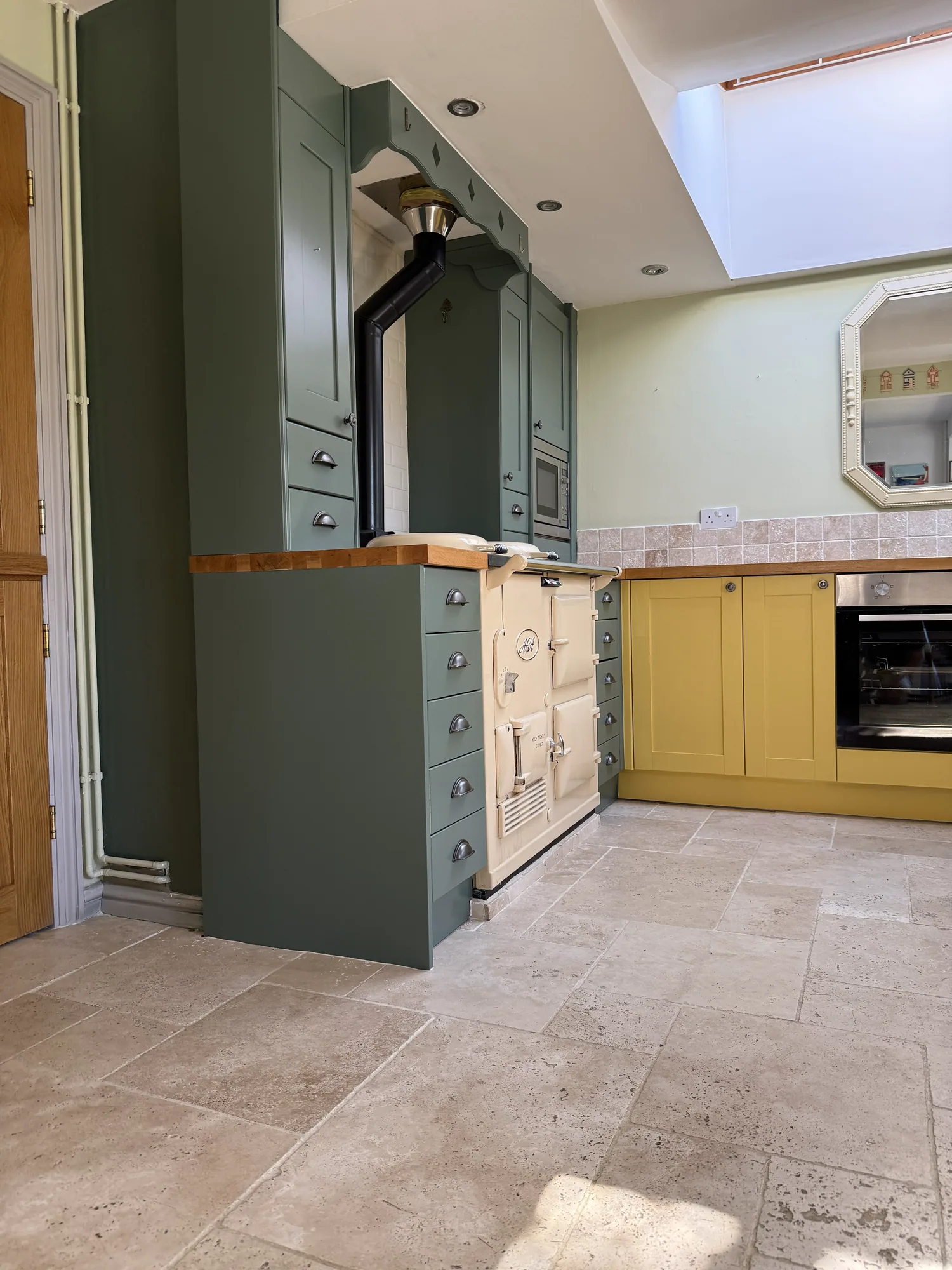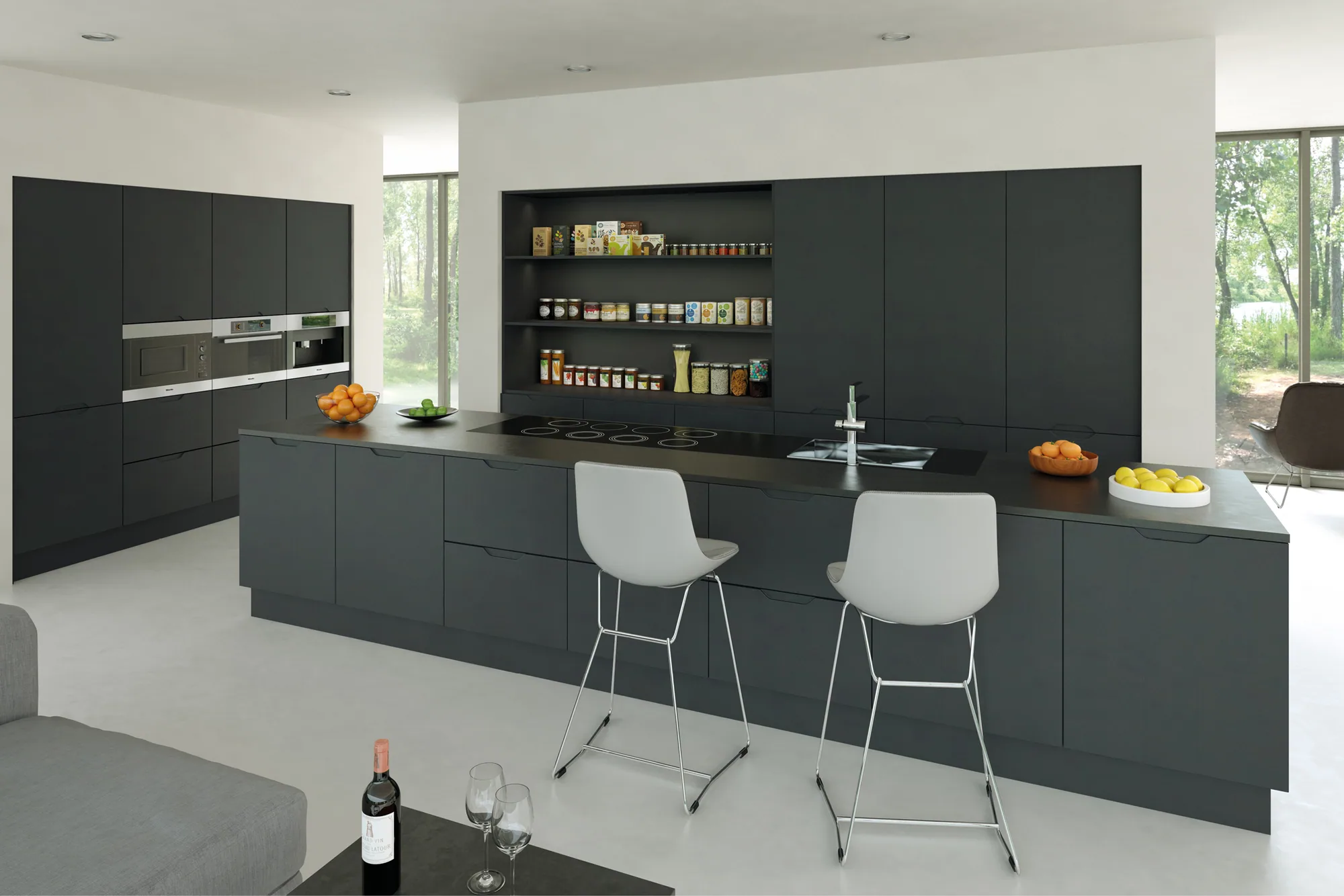
Bella door styles fall into three broad families: shaker and traditional, flat slab and handleless, and in-frame or detailed. The style sets the character of the kitchen and the colour sets the mood.
Across the 36 styles there are 2,242 style and colour combinations in the range. Handed a list that long, most people freeze, pick the thing that looks like their neighbour's kitchen, and hope. There is a much easier way in, and it is that those 36 styles really only come in three families. Once you know which family you are in, you are choosing between a handful of doors instead of thirty six, and the rest is colour.
The Three Style Families
Every kitchen door is doing one of three things with its face. It either has a recessed centre panel with a frame around it, it is completely flat, or it has extra detail worked into it to imitate a made-to-fit, in-frame kitchen. That is genuinely the whole map.
- Shaker and traditional: a plain frame around a recessed panel. Richmond, Shaker, Westbury and Knebworth sit here. Safe in the best sense, and the hardest style to get wrong.
- Flat slab and handleless: no frame, no panel, just a clean face. Integra, Integra Full Handle, Euroline and Segreto. Modern, quiet, and it lives or dies on the finish you pick.
- Detailed and in-frame looks: more shaping and more shadow lines. Carrick, Tullymore, Aysgarth and Helmsley. These carry the character of an older or more expensive kitchen.
All of them are made to measure for the cabinets you already have, which is the point of the whole exercise. Your carcasses, layout, plumbing and worktops stay put. You are changing the face of the kitchen, not the kitchen. That is covered in more detail on the replacement doors page.
Shaker and Traditional
If you are in a cottage, a period property, a farmhouse or anything with beams, uneven walls or original features, start here. A shaker door has a frame and a recessed flat panel, and that recess catches a soft shadow all the way round. In a room with low light or small windows, which describes most older Suffolk and Essex properties, that shadow is what stops a run of units reading as a flat wall.
Within the family there is a fair range. A standard Shaker is the plainest and the most flexible. Richmond and Westbury bring a slightly wider frame and a bit more presence, which suits larger rooms where a thin frame would look mean. Knebworth sits between the two. In a small kitchen a narrower frame keeps things light, because the frame width is what your eye reads as visual weight.
Shaker is also the family that ages best. It has been around long enough that it no longer reads as of any particular decade, which matters if you are planning to sell within a few years or you just do not fancy doing this again soon.
Want to See the Styles in Person?
Call us on 0800 246 5400 and we will bring samples to you. Free survey, free written quote, no obligation, across Suffolk, Essex and Cambridgeshire.
Book a Free SurveyFlat Slab and Handleless
Flat slab doors are exactly what they sound like: one clean, uninterrupted face. Integra, Euroline and Segreto all sit in this family, and Integra Full Handle adds a continuous grip rail along the door so you get the handleless look without any separate ironmongery on the front.
These suit new builds and open plan spaces, and there is a practical reason as well as an aesthetic one. In an open plan room the kitchen is furniture that happens to cook, and it is in view from the sofa all evening. A flat, handle-free run reads as a wall of cabinetry rather than as a kitchen, which is usually what people want when the kitchen and the living space share a room.
The catch is that a flat door has nowhere to hide. There is no frame, no shadow line and no detail to break up the surface, so every choice you make about finish shows. A slab door in the wrong sheen in a bright room is the one combination people most often regret. That is why finish matters more here than anywhere else.
Worth mentioning too: handleless does not mean nothing to grip. A grip rail or a routed lip works fine, but it is a different everyday feel to pulling a bar handle. If you have anyone in the house with reduced grip strength, it is worth trying a sample before committing.
In-Frame and Detailed Looks
The third family is for people who want the kitchen to look like joinery rather than like units. Carrick, Tullymore, Aysgarth and Helmsley all bring extra shaping: deeper profiles, additional beading, and edge detail that throws more shadow than a plain shaker.
A true in-frame kitchen, where the door sits inside a visible timber frame, is a very expensive thing to buy. These styles give you a lot of that character on doors that fit your existing cabinets, which is a completely different budget. In an older property with generous ceiling heights they look entirely at home.
Two warnings, both honest ones. First, more detail means more edges, and more edges means more places for dust and cooking residue to sit. It is a wipe rather than a chore, but it is a wipe you do not have with a slab door. Second, detailed doors need room to breathe. In a galley kitchen or a small back-of-house kitchen, heavy detail on every door can crowd the space. If you love the look but the room is tight, one option is a plainer style on the doors with the detail kept for an island or a dresser unit.
How Finish Changes the Room
Finish is the single most underrated decision in a new kitchen, and it changes daily life far more than the style does. Colours span supermatt, matt, paintflow matt, satin, high gloss and wood effects, and each behaves differently once it is on your wall in your light.
- Supermatt: absorbs light almost completely, no reflection at all. Deep colours look their richest here. It reads as expensive and modern. The trade off is that it shows fingerprints on darker colours, so a dark supermatt next to a busy family sink gets wiped often.
- Matt and paintflow matt: a very slight softness to the surface without the total flatness of supermatt. Paintflow matt in particular is a good middle ground and reads closest to a hand painted kitchen.
- Satin: a gentle sheen. Forgiving, easy to keep clean, and the most sensible choice for a kitchen that gets heavy daily use with children about.
- High gloss: bounces light around, which genuinely helps a dark or north facing room feel bigger. It also reflects everything, including the state of the room, and shows smears more readily than any other finish.
- Wood effects: Halifax Natural Oak, Lissa Oak, Urban Oak and Cremona Oak among them. Grain adds warmth that a flat colour cannot, and it is very forgiving on marks because the pattern breaks up the surface.
The rule of thumb we give people: look at where your windows are. A bright south facing kitchen can take supermatt and deep colour without going gloomy. A dark north facing kitchen usually wants satin, gloss or a warm wood effect, because a flat dark finish in poor light just goes heavy.
Choosing Colour Last, Not First
Almost everyone does this the wrong way round. They fall in love with a colour on a screen, then try to find a door that comes in it. Do it the other way. Settle the style family first, because that decides the character of the room. Settle the finish second, because that decides how the room feels in your light and how much wiping you sign up for. Then choose the colour, which is the easiest part and the part with the most options.
A few things worth knowing about colour in a real kitchen. Colour looks different at 7am and at 7pm, so live with a sample for a few days before deciding. Colour also looks different at scale: a shade that is pleasant on a small sample can be overwhelming across twenty doors, and it is worth going one step lighter than the sample you liked. And your worktop is roughly a third of what you see, so any colour decision made without the worktop in the room is only two thirds of a decision. If your worktops are tired, that is worth pricing at the same time on our worktop refinishing page.
The quickest way to narrow it down is the interactive door style explorer on our replacement doors page. Pick a style and it shows you every colour and finish that style comes in, which is a far better way to shop than scrolling a list of 127 names. Once you have a shortlist of two or three, we bring physical samples to the survey. Screens lie about colour. Samples do not.
One last option people often do not realise is available. If you want new doors but the visible frames, end panels and plinths are staying, we spray those to match the new doors exactly, in the same workshop-and-on-site way we do a full kitchen respray. Because both halves are ours, the match is controlled rather than hoped for.
Frequently Asked Questions
Yes. Bella doors are made to measure for the cabinets you already have, which is the whole point of the service. We measure every door and drawer front at the survey, so the new fronts fit your existing carcasses. Your layout, plumbing and worktops all stay exactly where they are. The main thing we check at survey is that the carcasses themselves are sound, because there is no sense putting new doors on cabinets that are failing.
Satin and wood effects are the most forgiving day to day. Satin has just enough sheen to wipe clean easily without showing every smear, and the grain in a wood effect breaks up the surface so marks are far less obvious. Supermatt in a dark colour and high gloss both look superb but show fingerprints more readily, so they suit kitchens that get a quick wipe rather than a busy family sink area.
You can, and two colours in one style is the version that works most reliably. A darker colour on the base units and island with a lighter colour on the wall units is a well proven combination and it keeps a low ceilinged room feeling taller. Mixing two different styles is harder to pull off and usually only works when the second style is confined to one element, such as an island or a tall dresser unit. We will be straight with you at the survey about whether a combination will read well in your particular room.
Start with the door style explorer on our replacement doors page. Choose a style and it shows you every colour and finish available in it, which narrows 2,242 combinations down to a shortlist quickly. Then book a free survey and we bring physical samples to your kitchen so you can see them in your own light, next to your worktops, at different times of day. Screens are not reliable for colour. The survey and written quote are free with no obligation.